

It’s Complicated - Why a “Yes” Vote for “Unfair” Districts in Virginia Is Actually Fair
By Holly Hazard

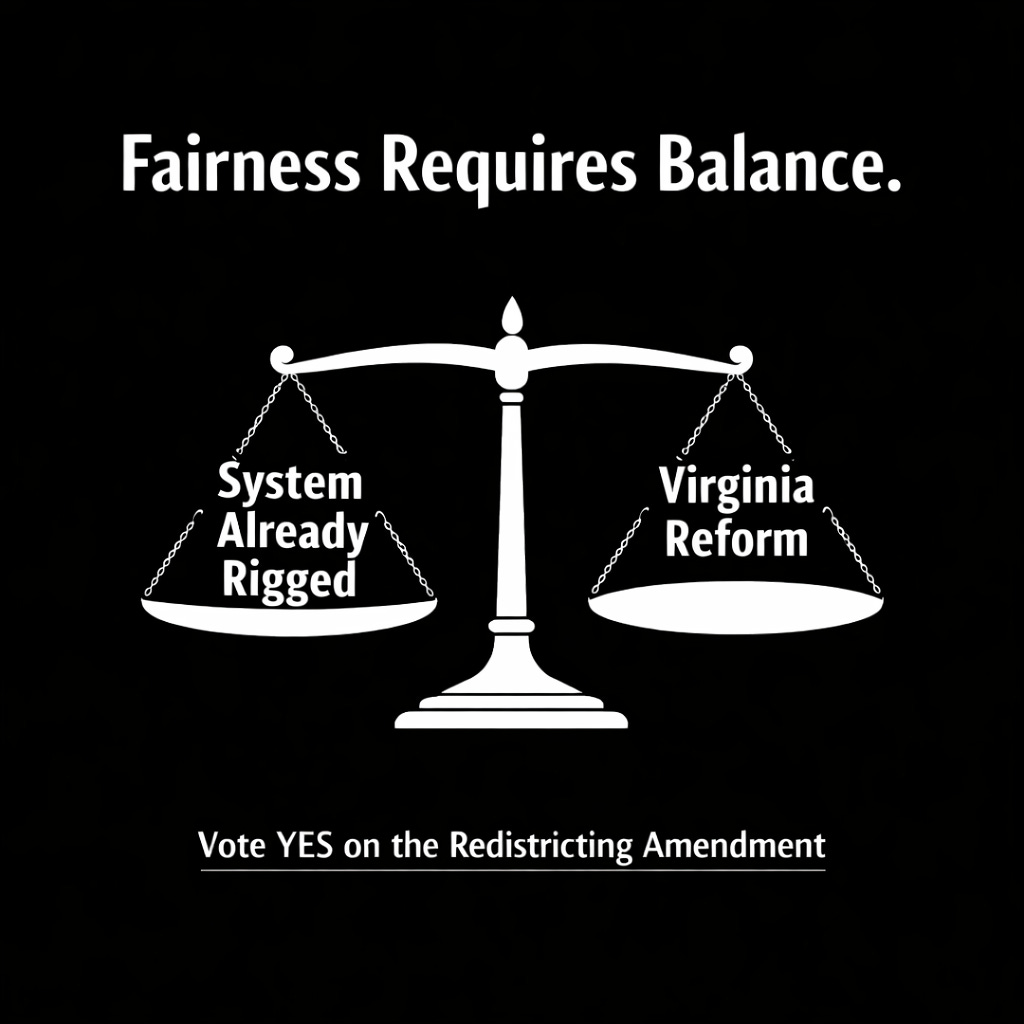
It’s Complicated —
Why a “Yes” Vote for “Unfair” Districts in Virginia Is Actually Fair
We like our civic arguments short, sharp, and slogan-ready. But some questions demand more than a bumper sticker. This spring’s redistricting vote is one of them.
A few years ago, Virginians did something admirable. We took map-drawing power out of the hands of the openly partisan Virginia General Assembly and placed it in a more neutral process. The first attempt wasn’t perfect, but the result was widely regarded as among the least gerrymandered congressional maps in the country. It was a good-faith reform.
So why would some of the same people who celebrated that reform now support a map that tilts hard in the opposite direction? And how can they call that fair?
Start with the national landscape.
In 2012, Democrats won the presidency by 5 million votes, the U.S. Senate by 10 million votes, and the U.S. House popular vote by 1.4 million votes—yet lost the House majority by 33 seats. The reason was partially due to aggressive gerrymandering in Republican-controlled states. The majority of voters did not elect the majority of representatives. That’s not a quirk. That’s structural distortion.
Congress attempted to ban partisan gerrymandering nationwide. The House passed reform. The Senate filibustered it. Reform died.
Then came another wave. In the post-2020 Census re-districting cycle, the Texas legislature pushed through an especially aggressive map designed to maximize Republican seats far beyond the state’s partisan balance. The Supreme Court then determined that federal courts won’t referee partisan gerrymandering. Other states—including Missouri, Ohio, and North Carolina—followed Texas’s suit. The cumulative effect is not subtle. It is a deliberate effort to lock in power irrespective of voter preference.
When one side rigs the rules and the other unilaterally disarms, the result is not virtue. It’s surrender. At the same time, the Republican-controlled Congress has shown itself not to be a full and separate power, but rather, for the first time in history, a cowardly group of sycophants that, unbelievably, can’t or won’t stand up to clear breaches of Constitutional and International law by the executive branch. By all accounts, our democracy is wavering on the precipice of becoming a system where power answers only to itself.
In response to the states push to consolidate power, California moved to give itself flexibility to offset some of the imbalance created elsewhere. Virginia now faces a similar choice: whether to insist on unilateral purity while others game the system—or to demand a level playing field.
Critics call this “unfair.” But that critique assumes we are operating in a fair system to begin with. We are not.
This is not about gerrymandering the Virginia General Assembly. It does not affect state legislative districts. It is temporary. It concerns only Virginia’s delegation to the U.S. House—a body already skewed by aggressive manipulation in other states. Virginia voters are being asked whether they are willing to absorb the full cost of reform while other states exploit its absence.
There is a difference between principle and passivity. A temporary corrective, adopted in response to systematic distortion, is not the same thing as endorsing distortion as a governing philosophy. The stated goal is not permanent advantage; it is parity. The commitment is to return to non-gerrymandered maps when the playing field is level nationwide.
If the Redistricting Amendment passes this spring, Virginia Republicans will continue to have the representation of Republican members of Congress. Unfortunately, they won’t be in Virginia-they are in the manipulated districts in Texas, Missouri and elsewhere. We can all agree this isn’t ideal. But it is the choice of Republicans, not Democrats. Restoring balance is not disenfranchisement; it is reciprocity.
As Alexander Hamilton famously wrote, energy in government matters. Or, as reimagined by Lin-Manuel Miranda in Hamilton, you don’t throw away your shot.
The most patriotic choice Virginians can make—Republican or Democrat—is to vote “yes” on the Redistricting Amendment on or before April 21. And when balance is restored nationwide, we restore it here as well.
Sometimes “unfair” is just fairness catching up.
Well said.
Beautifully written! Great discussion and explanation.